Reflections on AI Coding
AI thoughts on the future of AI in coding
- AI
- Thinking?
AI used to be inconsistent for coding. I remember trying to use GitHub Copilot at the beginning of 2025, and I wasn't really impressed. I had to rewrite a lot of code to get something working as a frontend developer.
But since the release of the latest Anthropic model (Opus 4.5), the AI code output has become truly impressive. I save time on almost every development task at my job.
However, this AI revolution is not without problems. I reflect on some of them here. This list is certainly incomplete, but I wanted to share my thoughts.
VS Code Hegemony
VS Code has been my go-to IDE since 2018. Later, I tried using the GitHub Copilot beta, but I wasn't impressed by its coding capabilities or responsiveness. So, I tried different ones to see if I could find a better integration of AI features.
I tried Cursor and Antigravity (Google). The main thing they have in common is that they are all built on top of VS Code. My experience has been very positive: Cursor provides a better experience than GitHub Copilot and Google Antigravity is nearly at the same level regarding AI features. The main one for me is the speed of the AI response and the fluidity of the exchange with the model.

If I were Microsoft, I would be annoyed to see other IDEs leveraging my work more effectively. VS Code is an open-source project and the license (MIT) allows any company to build on top of it.
Standardization of AI conventions
AI is still recent but the conventions are not always harmonized. For example, Anthropic is pushing for a CLAUDE.md to give initial instructions to the model. Google is pushing for a GEMINI.md on Antigravity and Cursor uses the standard AGENTS.md.
This is a kind of fragmentation that I find a bit annoying. Each project should have the same conventions of files to make it easier to switch between tools. The workaround currently is to create a symlink to support multiple files.
I am hoping this will be resolved in the near future.
Opaque Usage & Consumption
Each IDE comes with a limited free version. If you want to use them intensively, you need a paid subscription. I'm not a fan of how Cursor or Antigravity handle it: it's not very transparent.
On Cursor, I have a $20/month subscription, yet my AI usage was paused after reaching $46 this month. It's frustrating because I don't know exactly how much usage I have left.
Antigravity isn't any better in this regard. You don't get much information about your consumption. If you pay for a subscription, Google simply states you have access to "more generous rate limits." That's not very helpful. Both lack the transparency I would expect from a paid service.
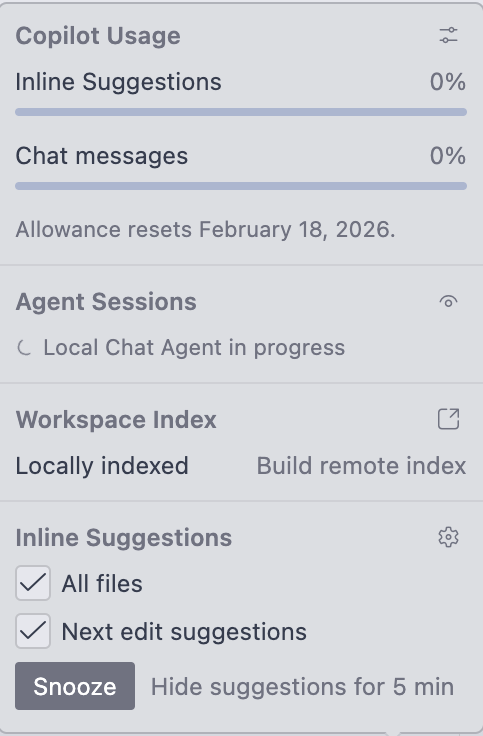
Unlike Cursor and Antigravity, GitHub Copilot shows a clear view of my consumption in a menu and a pricing multiplier depending on the model used.
A small note about the ecological impact of AI. It is good to remember that each AI model development, request, server, etc. costs a lot of energy and resources: so use your model wisely and keep using your brain 😁.
Unsustainable Pricing
AI pricing is currently incorrect. The price of AI is not based on the real cost of it (research, servers, etc.) but is subsidized by private (and some public) funding.
So currently, when you make a request to an AI model, you pay a fraction of the cost you should pay. A good example is the Netflix subscription: it was cheap for a long time, but is getting more and more expensive. Why? Because the company needs to recoup its investment and make a profit.
It is good to remember AI is cheap to use for now, but it will not stay this way. This will impact our jobs and the structure of the market. In the future, companies might charge clients for machine time rather than human time, selling AI subscriptions to develop their websites or apps.
Data Sovereignty Concerns
One problem I have with AI is data sovereignty. The United States takes the lead in AI research and development, especially in coding AI. When I look at code benchmarks, the top three models are all from the United States (Anthropic, Google, OpenAI) (at the time of writing).
With the current geopolitical context, it's important to have alternatives developed and deployed near us. Currently, none of the models from Europe are in the top 10. If I look at Mistral, one of the top models in Europe, it is ranked 29th (at the time of writing).
This post might seem a bit negative, but I think it's important to reflect on these issues. As a developer, I see a growing usage of (and dependency on) AI in our daily tasks, prompting reflections on how I do my job.
Will we even need a full IDE to use AI anymore? Cursor has introduced an "agent-only" mode. Given the development of tools like Claude Code or Open Code, maybe that's where we're headed.
In my next article, I will be more positive and concrete. I plan to discuss how I use AI to code as a frontend developer using Figma MCP Server capabilities. Stay tuned!